|
Order
printed book from Oxford University Press (copies available from 14 August 2026)
Download Open Access
(published 2 August 2026)
Software made available with Brain Computations
Review of its predecessor in Brain
|
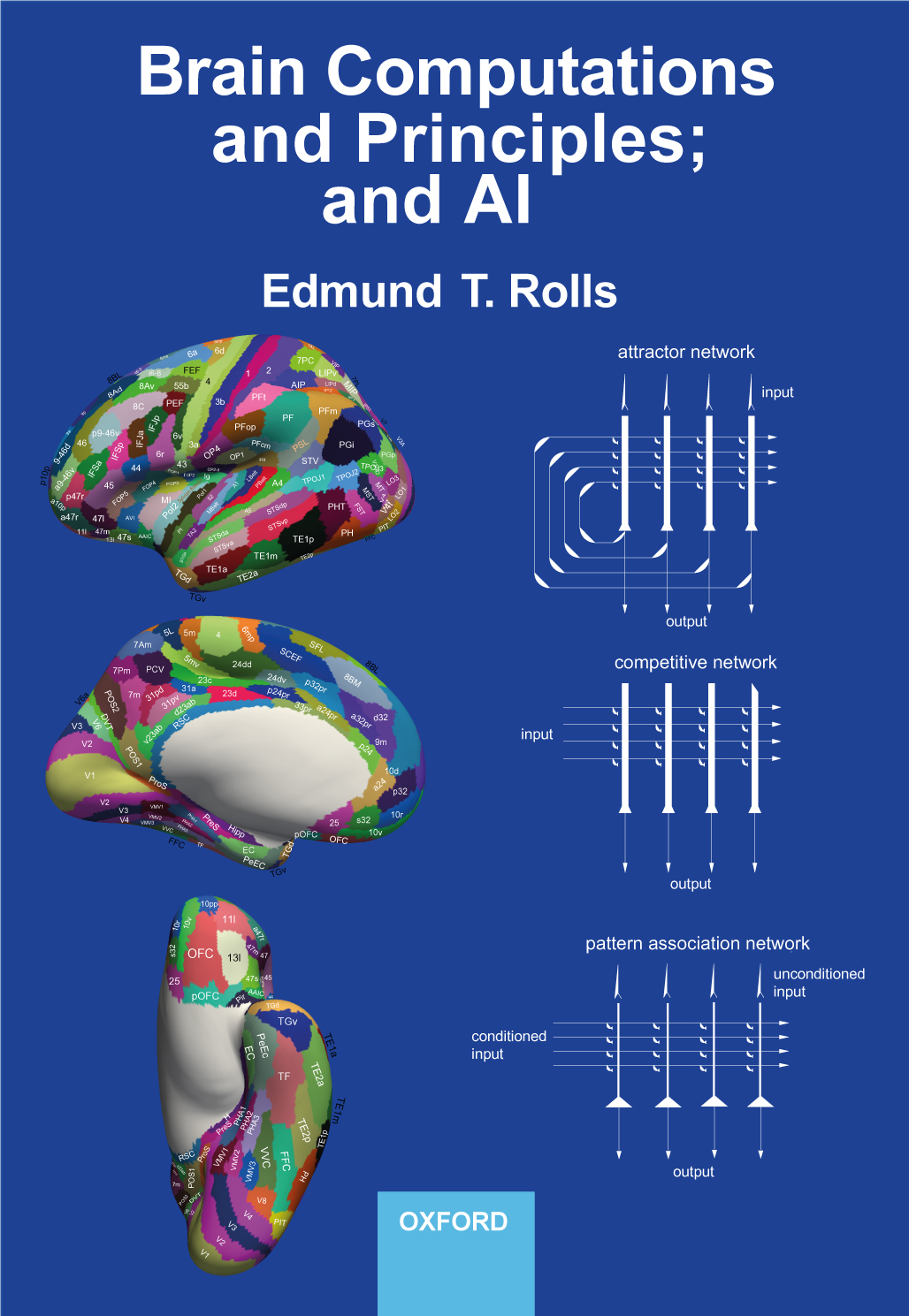
Brain
Computations and Principles; and AI
Oxford
University Press.
ISBN 9780197920961
doi: 10.1093/oso/9780197920961.001.0001
Brain
Computations and Principles; and AI considers what is computed by each
brain region, how it is computed, and how the connectivity between
brain regions facilitates the computations.
The book also considers the principles of brain computations.
The book also compares brain computations to those in AI, and argues
that they are very different, but can usefully complement each other.
The book focusses on the primate including human brain, to make it
relevant to understanding the human brain in health and disease
including mental disorders.
Brain Computations and Principles; and AI is about how the brain works. In order
to understand this, it is essential to know what is computed by
different brain regions; how the computations are performed; and how the brain regions are connected.
The aim of this book is to elucidate what is computed in different
brain systems; and to describe current computational approaches and
models of how each of these brain systems computes.
Understanding the brain in this way has enormous potential for
understanding ourselves better in health and in disease. Potential
applications of this understanding are to the treatment of the brain in
disease; and to artificial intelligence which will benefit from
knowledge of how the brain performs many of its extraordinarily
impressive functions.
This
book is pioneering in taking this approach to brain function: to
consider what is computed by many of our brain systems; and how it is
computed, and updates the earlier book: Rolls (2023) Brain Computations
and Connectivity: Oxford University Press by much new evidence and by a
set of 16 added chapters on
the Principles of Brain Computation.
Brain Computations and Principles; and AI provides a computational framework
for understanding brain function in health and disease. The book also
compares brain computations to AI computations, and suggests how each could benefit from the other.
Brain Computations and Connectivity will be of interest to all scientists
interested in brain function and how the brain works, whether they are
from neuroscience, or from medical sciences including neurology and
psychiatry, or from the area of computational science including machine
learning and artificial intelligence, or from areas such as theoretical
physics.
The Gatsby Charitable Foundation is thanked for a grant towards the cost of enabling this book to be Open Access.
|